
Introduction
Customer support is the heartbeat of any business. When customers receive fast, accurate, and professional support, trust automatically increases.
But providing 24/7 support, giving correct answers, maintaining speed, and reducing operational cost — all these things are difficult with a human-only team.
This is where AI-based customer support automation fills the gap.
It helps businesses achieve 2X growth, 90% time-saving, and up to 80% cost reduction.
The main goal of Customer Support Automation is simple:
“AI handles repetitive support tasks, while humans handle complex issues.”
An AI-powered system can automatically manage:
Frequently Asked Questions (FAQs)
Order tracking
Appointment scheduling
Billing & payment queries
Return/Refund requests
WhatsApp & Email support
Support ticket creation & assignment
This means customers get instant answers, and the business gets 24/7 support automation.
1. What is Customer Support Automation?
2. Why Businesses Need AI Support (2025 Reality)
2.1 24/7 Availability
A human team works 8–10 hours a day.
AI bots work 24/7, 365 days, without breaks.2.2 Zero Human Errors
Human agents get tired, make mistakes, or lose focus.
AI delivers 100% consistent, accurate responses.2.3 Up to 80% Cost Reduction
A single AI system can replace multiple support agents.
Once trained and integrated → it works forever at a very low cost.2.4 10X Faster Response Time
Human average response time: 45 seconds to 2 minutes.
AI response time: 0.3 seconds.
Customers want fast answers — AI delivers exactly that.
3. How AI Customer Support Actually Works (Deep Workflow)
Step 1: Customer Message Detection
Customer asks: “What is the status of my order?”
AI classifies the message as:
Order, Complaint, Inquiry, Billing, or Technical Issue.
Step 2: Identity Verification
AI automatically detects:
Phone number
Email
Customer name
Order ID
No repeated questions.
Step 3: Database Integration
AI fetches real-time information like:
Order status
Shipment details
Delivery partner
Payment history
Invoice details
Step 4: Instant Accurate Response
Example:
“Your order #2258 will arrive on 14 December via Delivery.
Tracking link: www.example.com/t/2258”
This happens within 0.5 seconds.
Step 5: Auto Ticket Creation (If Needed)
For complex cases like damaged product, wrong item, or replacement:
AI automatically creates a support ticket, assigns it to the correct department, and sets priority.
Step 6: Follow-Up Automation
AI sends automated updates like:
“Your issue is being reviewed.”
“Replacement approved.”
“Refund has been initiated.”
Customers always stay informed.
An eCommerce brand had:
400 customer queries per day
3 support agents
Average response time: 3 minutes
30–35 complaints per day
After AI automation:
330 out of 400 queries handled by AI
Human workload reduced by 70%
Cost saving: ₹2.5 lakh per month
Response time: 0.5 seconds
Complaints reduced from 35 to 5 per day
The entire support system transformed.
4. Real Case Study (Example)
5. Benefits That Truly Matter
A) Zero Waiting Time
Instant replies = happier customers.
B) Personalized Support
AI remembers customer history and gives customized answers.
C) Multi-Language Support
English, Hindi, Gujarati — all handled by AI.
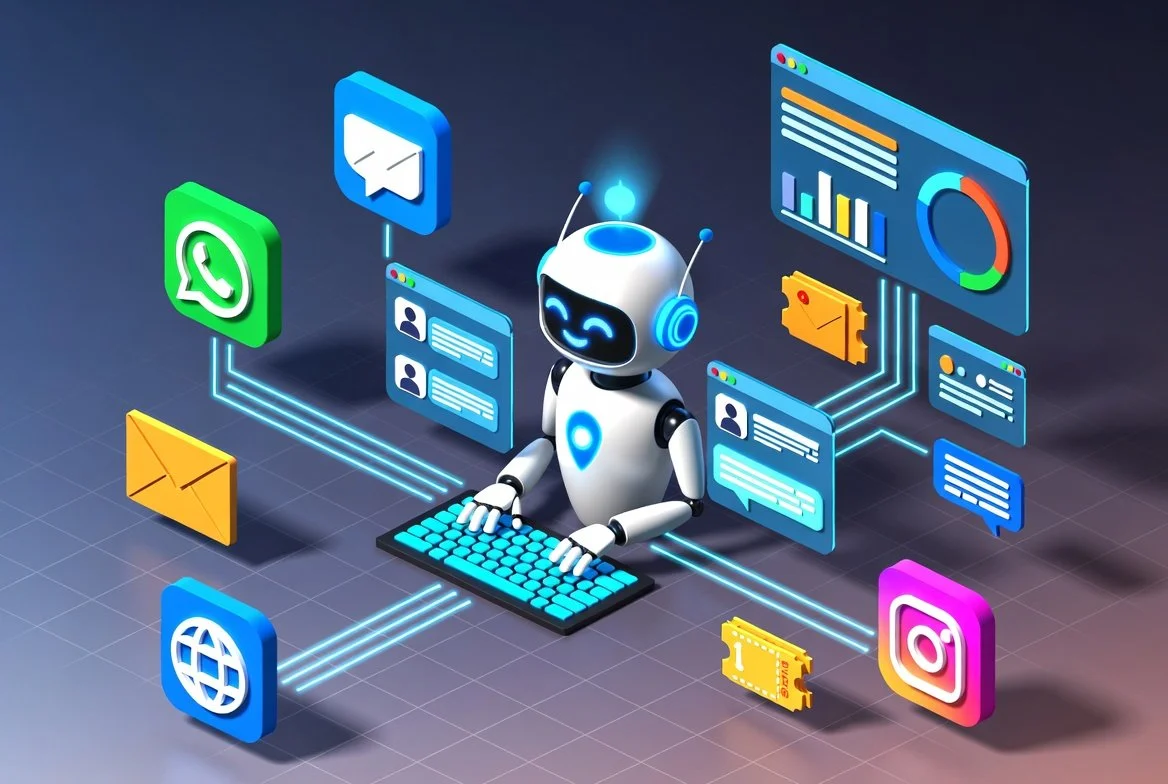
D) Works Across All Platforms
WhatsApp
Instagram DM
Facebook
Email
Website Chat
SMS
Telegram
One AI system works everywhere.
E) Data-Driven Insights
AI provides actionable analytics:
Which queries are most common
Peak support hours
Customer satisfaction score
Repeated issues
This helps the business make smarter decisions.
The future of AI support includes:
Emotion detection through text
Predictive support before issues arise
Fully voice-based AI support
Auto-refund and auto-approval systems
Complete autonomous support agents
Small businesses to large enterprises — everyone is adopting this.
6. Future of Customer Support (2025–2030)
• Conclusion
Customer Support Automation is no longer optional — it is a business necessity in 2025.
With AI, businesses can reduce costs, increase customer satisfaction, improve response speed, and free their human team from repetitive work.
AI customer support automation is the most powerful, future-proof strategy for modern businesses.